What the letters mean
PFAPA summarizes four common findings: periodic fever, mouth ulcers, throat inflammation, and enlarged neck glands.

General information
PFAPA is an inflammatory syndrome that causes repeated episodes of fever, usually along with mouth sores, sore throat, or swollen neck glands. This page offers a short and clear explanation for families and curious visitors.
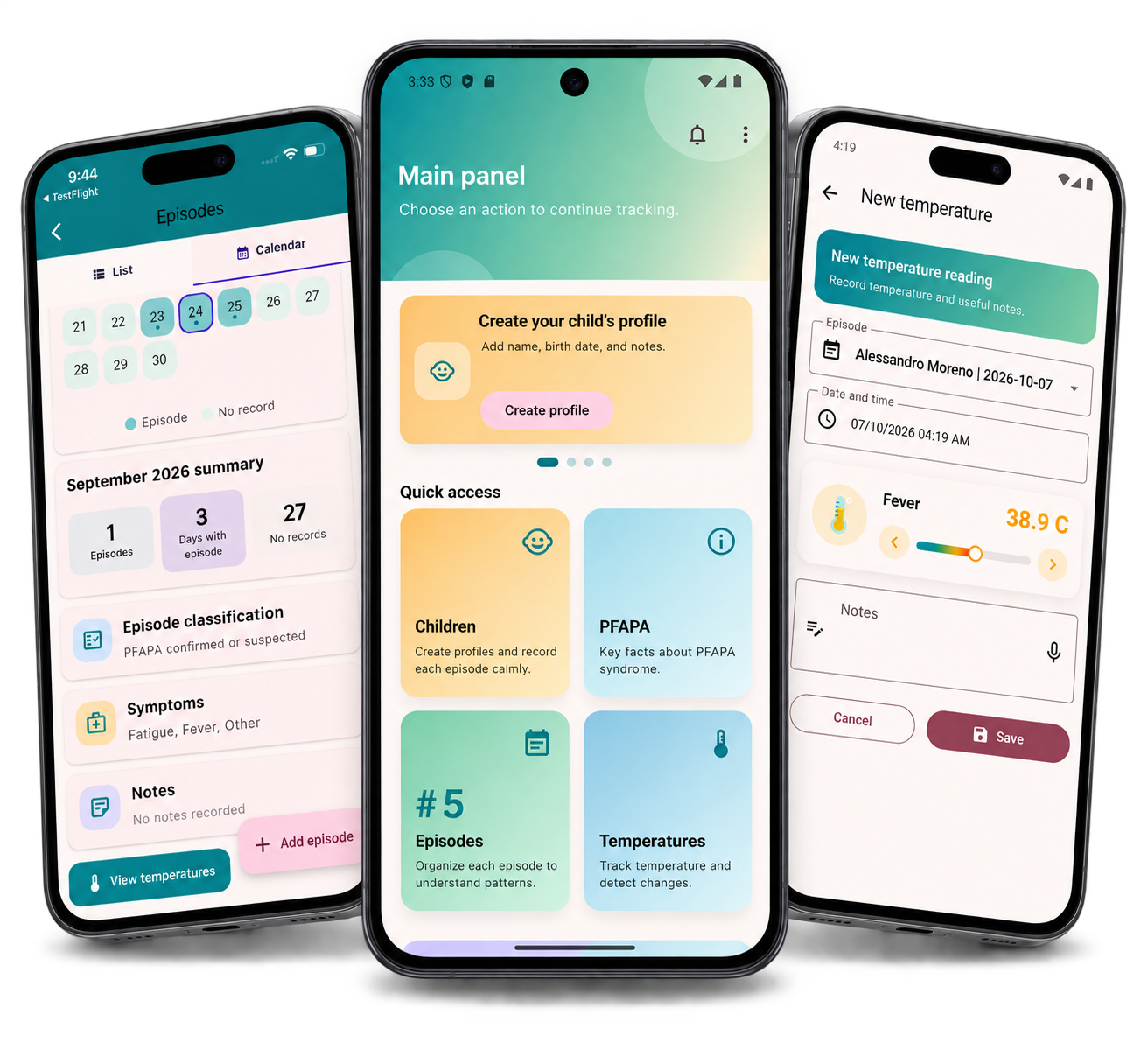
PFAPA stands for periodic fever, aphthous stomatitis, pharyngitis, and cervical adenitis. It is considered an autoinflammatory syndrome rather than a contagious infection, and it often appears in episodes with some regularity.
PFAPA is also known as Marshall syndrome with periodic fever, listed as a synonym in Orphanet · PFAPA (ORPHA:42642) ↗.
Between episodes, many children look well, return to their normal routine, and grow as expected. That is one reason why organized tracking can help identify patterns and support conversations with a pediatrician.
PFAPA summarizes four common findings: periodic fever, mouth ulcers, throat inflammation, and enlarged neck glands.
Episodes often come back every few weeks and may last several days. In many families the pattern becomes fairly predictable.
PFAPA is not generally described as an infection that spreads from one person to another. Even so, symptoms should be assessed by healthcare professionals to rule out other causes.
Fever comes in repeated episodes and is often the symptom families notice most.
During an episode there may be pharyngitis, redness, or pain when swallowing.
Some children develop small painful sores inside the mouth.
Enlarged cervical lymph nodes are commonly noticed during flares.
Some children may also have malaise, abdominal pain, headache, joint pain, or tiredness.
Outside flare periods, many children feel well and do not show obvious symptoms.
PFAPA usually begins in early childhood, often between ages 2 and 5, and frequently before age 5.
In many children the episodes become less frequent over time, and the condition may resolve in later childhood or before adolescence.
Some cases may persist longer or appear at older ages, which is why medical evaluation still matters.
This information is general and does not replace diagnosis or instructions from healthcare professionals.